a CVSS 2.7 ESX logging bug just landed on CISA KEV because spies used it as a zero-day
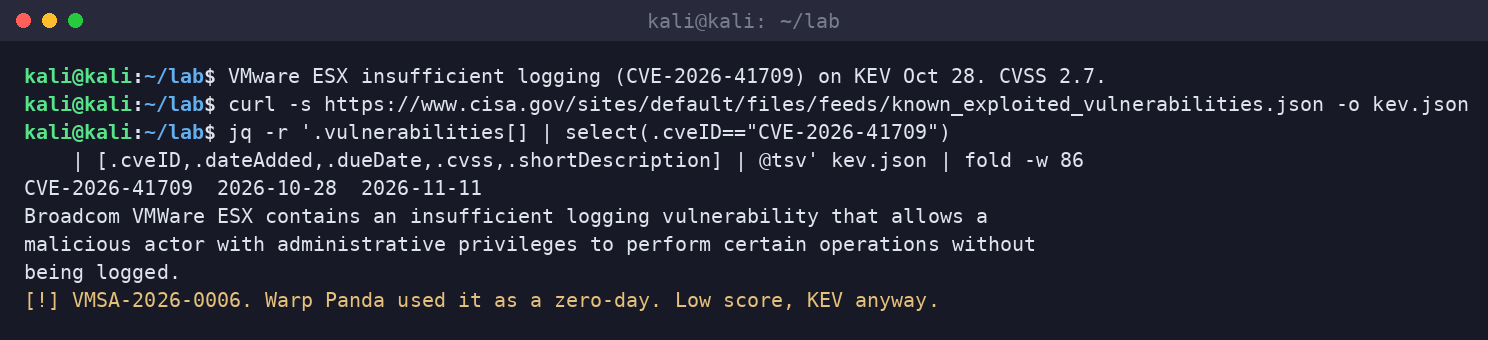
most people ignore Low severity advisories. china-nexus operators do not. CVE-2026-41709 lets a malicious ESX administrator perform certain operations without them being logged, and CrowdStrike says Warp Panda used it as a zero-day against US orgs, including law firms. CISA put it on KEV on October 28. the sloth would like your vSphere patch matrix back on the whiteboard.
what the KEV entry actually says
- CVE-2026-41709, “Broadcom VMWare ESX Insufficient Logging Vulnerability.” a malicious actor with admin access can perform certain operations without being logged.
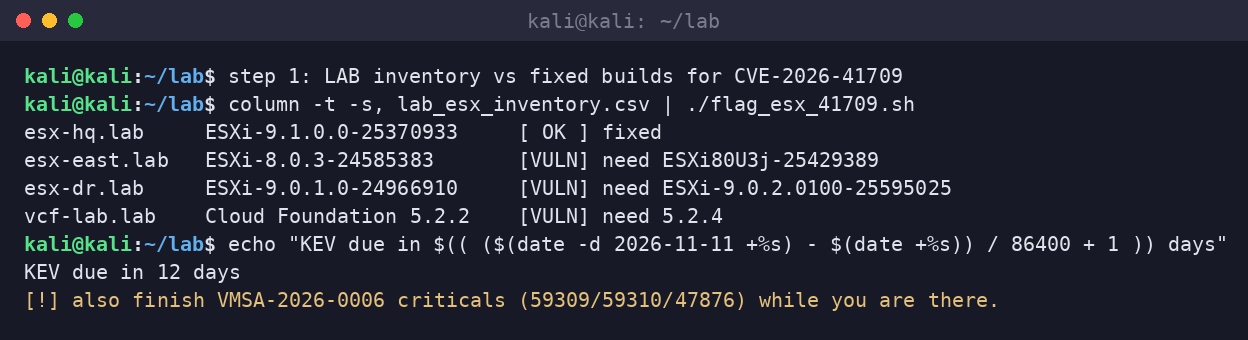
- affected: ESX 9.1.x before ESXi-9.1.0.0-25370933, 9.0.x before ESXi-9.0.2.0100-25595025, 8.0 before ESXi80U3j-25429389, Cloud Foundation 5.x before 5.2.4, Telco Cloud Platform 5.0.x / 5.1.x.
- fixed: the builds above. no workaround. Broadcom thanked Ian Barton of CrowdStrike for the report.
yes, 2.7 is on KEV. CVSS assumes you care about confidentiality, integrity, and availability of the asset. attackers care about whether your SIEM ever sees the admin action that plants BrickStorm. different scorecards.
why a logging bug matters at all
- admin is already the goal. Warp Panda, per CrowdStrike, gets in through internet-facing edge devices, pivots to vCenter, and deploys custom implants (BrickStorm, TetanusStorm, SharpStorm, DualGauge, GuestConduit). once you are admin on ESX, a missing log line is how you stay there.
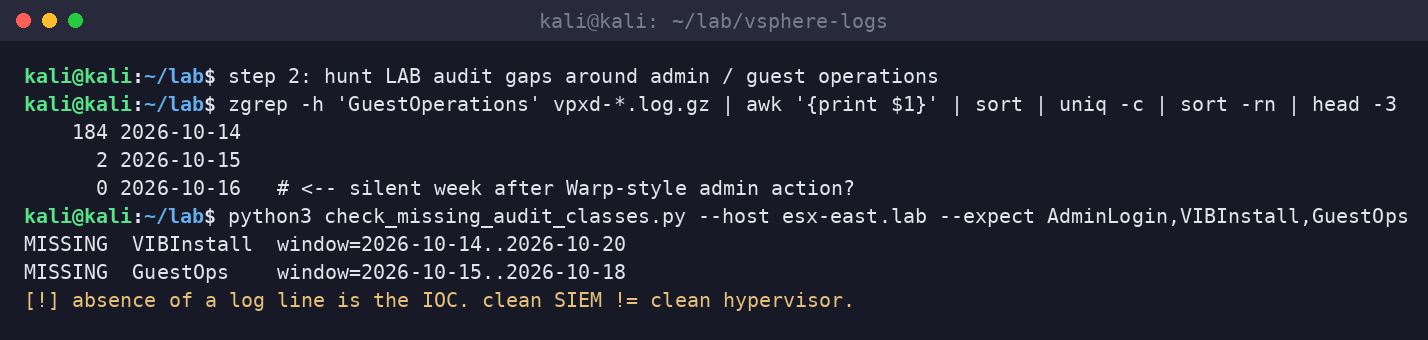
- zero-day window. CrowdStrike says the latest intrusion where it saw this CVE used as a zero-day was early 2026, months before the July disclosure. that is a long quiet period of “nothing in the audit trail.”
- legal sector targeting. CrowdStrike flags US law firms as a collection target: client communications, M&A materials, litigation strategy. a hypervisor with a mute button is a gift.
this is also why the July VMSA that bundled the 9.8 vCenter auth bypasses with a 2.7 logging bug was not “four criticals and a footnote.” the footnote was the persistence layer.
what to do before November 11
- patch ESX to ESXi-9.1.0.0-25370933, ESXi-9.0.2.0100-25595025, ESXi80U3j-25429389, or Cloud Foundation 5.2.4 / the Telco KB as applicable. there is no workaround.
- while you are there, finish VMSA-2026-0006. the same bulletin covers CVE-2026-59309 and 59310 (vCenter auth bypass / directory traversal, CVSS 9.8) and CVE-2026-47876 (VMXNET3 OOB write, 9.3). if 41709 is open, those probably are too.
- hunt like the log gap already happened. look for unexpected vCenter / ESX admin sessions, new VIBs, unusual guest operations, and the CrowdStrike-named implant families on any host that was reachable from an edge breach.
- verify logging after the patch. pick a sensitive admin action in a lab, confirm it lands in the expected ESX / vCenter audit stream, and make sure your SIEM still parses it. a patched host that ships logs into a black hole is still quiet.
- lock down who is “admin.” reduce standing ESX root and vCenter administrator membership. MFA and break-glass accounts beat shared root passwords from 2019.
sloth take
severity ratings are a suggestion. exploitation is a fact. a logging flaw with admin prerequisites looks boring until the adversary already has admin, and then it is the difference between “we caught them in week one” and “we found BrickStorm in month six.” Warp Panda noticed. CISA noticed. your patch ticket for a 2.7 should notice too.
if your edge stack or storefront still has a KEV item open, get a second set of eyes before the federal deadline. Book a slot with Dark Edge Consulting.
sources
- CISA, “CISA Adds Two Known Exploited Vulnerabilities to Catalog” (October 28, 2026) and KEV entry for CVE-2026-41709
- Broadcom, VMSA-2026-0006.2 (July 29 / August 19, 2026)
- CrowdStrike reporting on Warp Panda and CVE-2026-41709 zero-day use (October 2026)
- SecurityWeek / Help Net Security coverage of the ESX logging zero-day (October 29, 2026)