Hunt Ivanti CVE-2026-104935 in Your Proxy Logs Before the Board Asks
Volexity handed defenders a beautiful tell: the URL says welcome.cgi, the header says wu.cgi or a /tmp MD5 path. If your reverse proxy logs custom headers, you can hunt this with grep before someone schedules a “synergy sync” about it.
CVE-2026-104935 is the Ivanti Connect Secure auth-bypass + RCE pair that hit CISA KEV on October 13, 2026. Full incident context is in our breaking piece. This post is the hands-on: build a tiny lab log, find the mismatch, confirm the MD5 race paths, and leave with copy-paste detections for your real SIEM.
What you need logged
On whatever sits in front of ICS (nginx, httpd, a WAF, a load balancer), log the request URI and the X-DSCGI-PATH header. In nginx that is roughly:
log_format ivanti '$remote_addr - $remote_user [$time_local] '
                  '"$request" $status $body_bytes_sent '
                  '"$http_referer" "$http_user_agent" '
                  '"X-DSCGI-PATH: $http_x_dscgi_path"';
access_log /var/log/nginx/ivanti_access.log ivanti;
If you do not log that header today, you are flying blind on this specific chain. Fix the logging, then hunt. Order matters.
Lab setup
We generated a 53-line synthetic access.log with normal welcome.cgi traffic mixed with five UTA0576-shaped POSTs from 108.165.147.64 (the Evoxt VPS IP Volexity published). Headers point at wu.cgi and at /home/runtime/tmp/<md5> paths. No real appliance was touched.
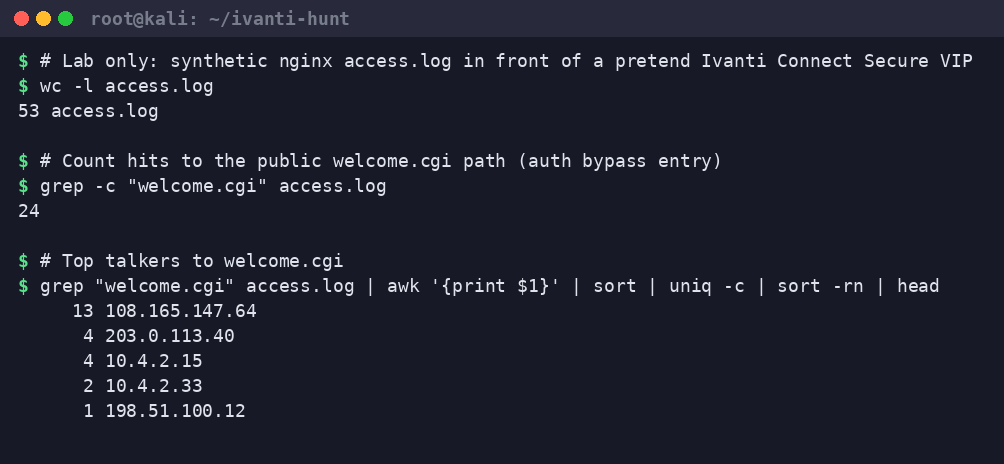
Step 1: who loves welcome.cgi
The auth bypass rides the public login path. Count it, then rank talkers:
grep -c "welcome.cgi" access.log
grep "welcome.cgi" access.log | awk '{print $1}' | sort | uniq -c | sort -rn | head
In the lab, 24 lines hit welcome.cgi. Thirteen of them are the planted attacker IP. Bursts from one host beat a slow drip from your users.
Step 2: the tell (header mismatch)
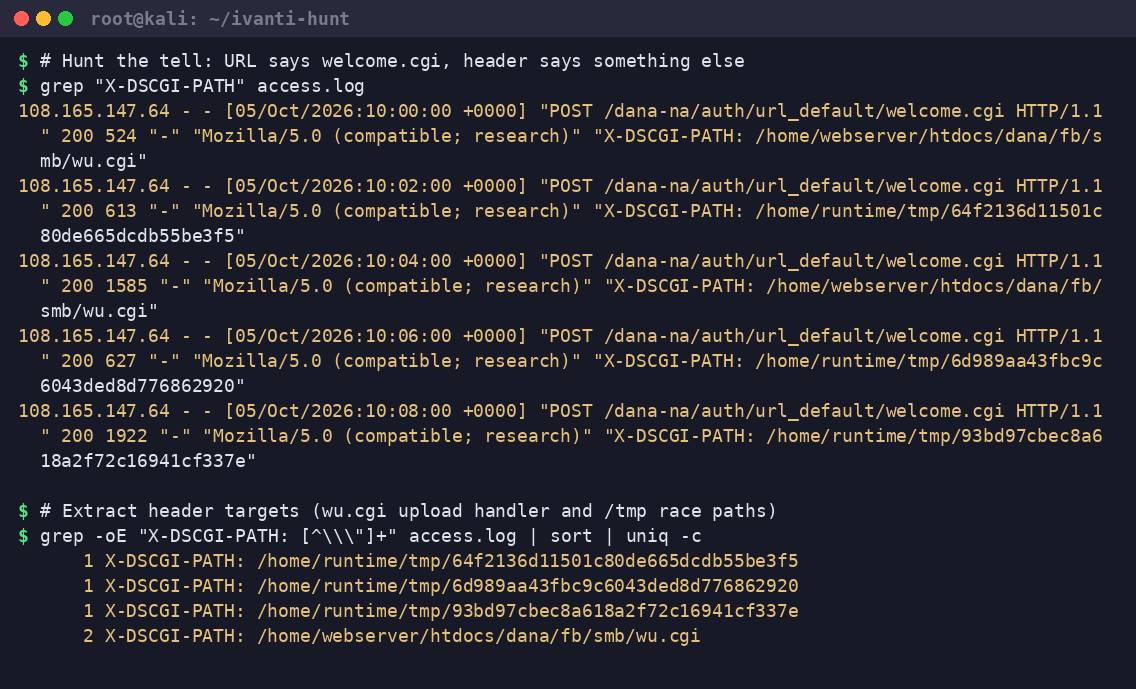
grep "X-DSCGI-PATH" access.log
grep -oE 'X-DSCGI-PATH: [^"]+' access.log | sort | uniq -c
Healthy traffic should not send X-DSCGI-PATH at all, or should never point it at wu.cgi / /home/runtime/tmp/ while the URL stays on welcome.cgi. Volexity’s guidance is blunt: monitor mismatches between the URL path and that header.
Step 3: confirm the MD5 race pattern
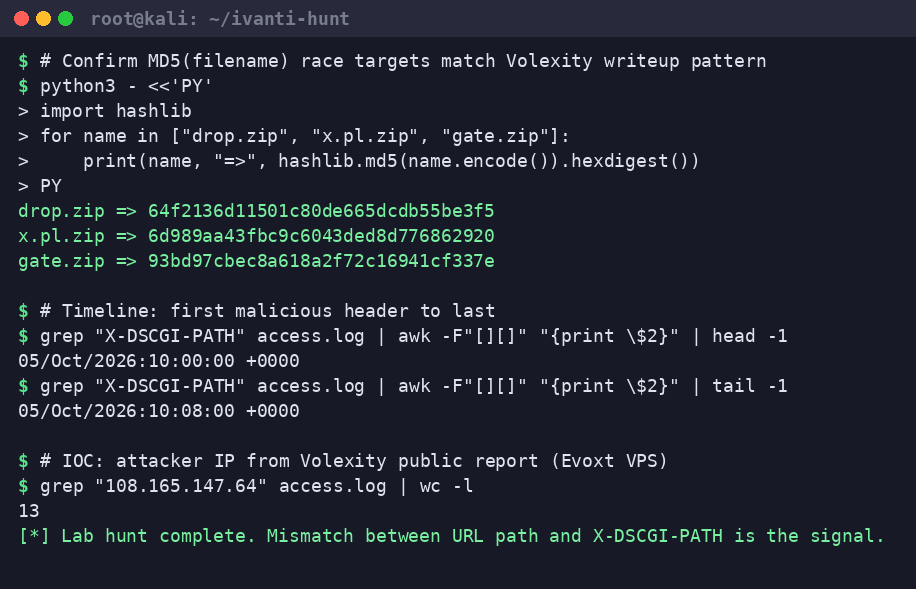
python3 - <<'PY'
import hashlib
for name in ["drop.zip", "x.pl.zip", "gate.zip"]:
    print(name, "=>", hashlib.md5(name.encode()).hexdigest())
PY

grep "X-DSCGI-PATH" access.log | awk -F'[][]' '{print $2}' | head -1
grep "X-DSCGI-PATH" access.log | awk -F'[][]' '{print $2}' | tail -1
grep "108.165.147.64" access.log | wc -l
Lab output: drop.zip hashes to 64f2136d11501c80de665dcdb55be3f5, which appears verbatim in the planted header. First malicious header at 05/Oct/2026:10:00:00, last eight minutes later. Thirteen total lines from that IP including recon GETs. That is enough to page someone.
Drop these in the SIEM
- Any request where URI contains
welcome.cgiANDX-DSCGI-PATHcontainswu.cgior/home/runtime/tmp/ - Rate spike: more than N welcome.cgi requests per 5 minutes from one source
- Known bad: 108.165.147.64 (rotate as intel updates; one IP is not a career)
- On the appliance (if you have shell): unexpected files under
/tmp/, sniffer binaries under hidden dirs like.icscap, gaps in debuglog / audit.log
Sloth take
Defenders keep asking for “advanced threat hunting” while leaving the one header that matters out of the access log. Log X-DSCGI-PATH. Grep for mismatches. Patch the appliance. Then you can go back to arguing about whether the SOC needs another dashboard.
Need a grown-up to look at your edge stack? Book a slot with Dark Edge Consulting. We do the boring, careful work so you can go back to ignoring your inbox.
Sources
- Volexity exploit-chain and detection guidance: volexity.com
- Rapid7 advisory summary: rapid7.com
- CISA KEV CVE-2026-104935: known_exploited_vulnerabilities.json
- Lab artifacts generated on-box 2026-10-13 (synthetic access.log + terminal captures)