Able2Shell: N-able pulls N-central offline after 30+ zero-days go public, no CVE and no hotfix yet
a researcher dumped more than 30 alleged zero-days for N-able N-central into public view, with working proof-of-concept code, and N-able responded by unplugging hosted N-central in every region and telling on-prem customers to switch theirs off too. your RMM, the thing with admin on every client you manage, is currently a paperweight by vendor request. honestly the safest it has ever been.
the disclosure, as the researcher tells it
- who and when. researcher Sean Bales published the set, branded Able2Shell, on LinkedIn and GitHub. N-able told BleepingComputer the communication came “late Sunday night, November 8.” GovInfoSecurity describes it as a Monday post. either way it was public by the time N-able declared the incident on Nov 9.
- how many. the researcher’s own post says “over 30 0-days.” Huntress and GovInfoSecurity count 33. we have not counted them ourselves, so: 30+, with 33 per Huntress and GovInfoSecurity.
- what was tested. “their latest pre-release version,” which BleepingComputer, Huntress and Previdian identify as N-central Appliance 2026.4.0.31. the researcher believes most if not all also affect earlier versions. that is the researcher’s belief, not something N-able has confirmed. N-able has not published an affected-version list.
- no coordination. Bales told BleepingComputer he skipped notifying N-able because earlier reports he filed on a different N-able product went unpatched for months. N-able did not answer that point. we report it as his account.
- AI-assisted. Bales confirmed to BleepingComputer the discovery was AI-assisted. welcome to the bug firehose.
what the bugs are (high level, as reported)
- the researcher lists anonymous credential theft, administrator creation and RCE as the
nableuser and as root, with chains including “XXE/NCI trust abuse, support-token theft, unsigned NSP execution, XSS-to-OGNL,” plus arbitrary file writes, traversal, credential disclosure, MDM impersonation, audit tampering, privileged-helper injection and a native GenericTCP stack overflow. - Huntress counts at least four distinct chains: three to remote code execution, one to privilege escalation to root.
- the headline chain, per BleepingComputer and Previdian: an unauthenticated XXE in N-central’s service-import functionality is used to grab a trusted internal session, reset an account password, log in, and run commands on the server as
nable. it can also create an enabled Default Administrator account. Bales told BleepingComputer this is the most critical one. - BleepingComputer notes it has not independently verified all of them. N-able building a hotfix suggests at least some are real. nobody outside N-able has a per-bug validity list yet.
exploitation status, no inflation
- N-able: no active exploitation seen, and later “no evidence of active exploitation or unauthorized data access.”
- Previdian: around 22:00 UTC Nov 9 (2:00 PM PT), one of its N-central decoys started getting SOAP requests aimed at the service-import surface, from a single source (5.231.45[.]175), mostly against
/dms/services/ServerUIwith some/dms/services/ServerMMS, including local-file and traversal attempts and an inline DOCTYPE pointing at a remote DTD. Previdian calls this probing, says it has not seen the full chain or the later password-reset and payload stages, and says exploitation is not confirmed. - so: public PoC, reported probing on a decoy, no confirmed exploitation. that is where it stands as of writing. it can change fast.
CVE, KEV, fix
- CVE: none assigned yet. Previdian tracks the XXE-to-RCE chain as VULN-2026-0007.
- CISA KEV: not listed. we checked the catalog (version 2026.11.09). for context, N-central already has three 2026 KEV entries: CVE-2026-18577 (added Aug 3), CVE-2026-18556 (Aug 4) and CVE-2026-86218 (Sep 8). this is not N-central’s first rodeo this year.
- fixed version: none. there is no patched build to upgrade to. N-able says a hotfix is coming. Huntress notes N-able does not always bump version numbers for live hotfixes, so do not assume a version string will tell you you’re fixed.
what to do right now
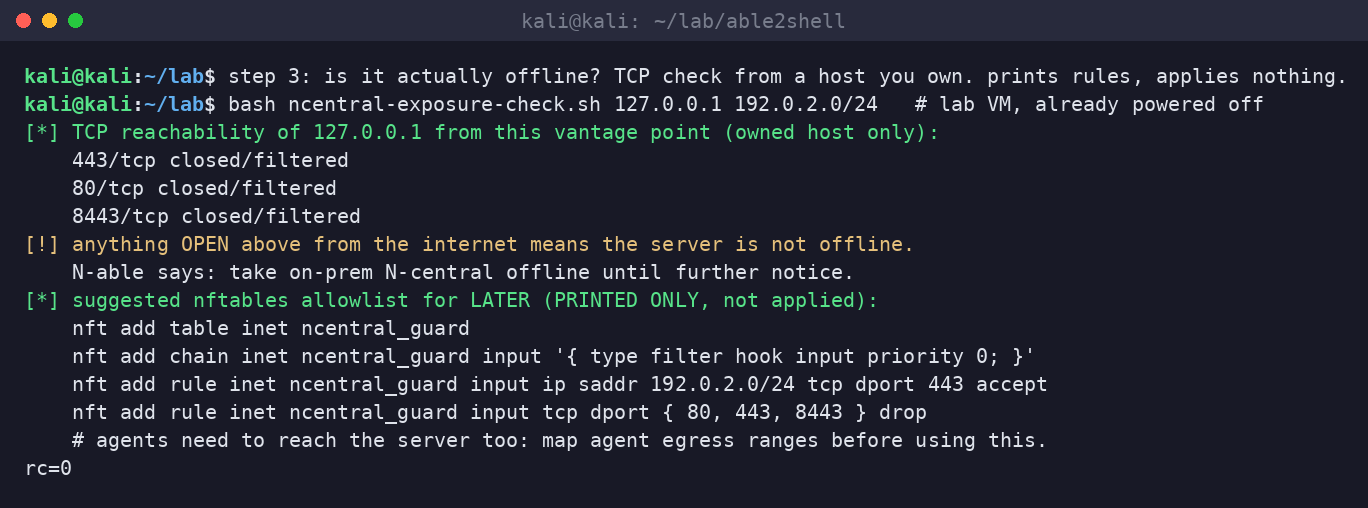
- follow N-able’s guidance. on-prem N-central: offline, and keep it offline until N-able says otherwise on its status page. hosted: it is already off, watch the status page. N-able says Ecoverse services through N-able Login (Asset View, Patching, Vulnerability Management, scripting, policies, tagging) remain available at n-able.app.
- preserve logs before you touch anything. web/access logs, N-central audit logs, authentication history. Previdian and Huntress both say this.
- triage for the reported surfaces. unusual SOAP calls to N-central DMS services and service import, DOCTYPE or external entity content, remote URLs, local-file paths, traversal, ApplianceLogSubmit activity. per Previdian, a hit is a lead, not proof.
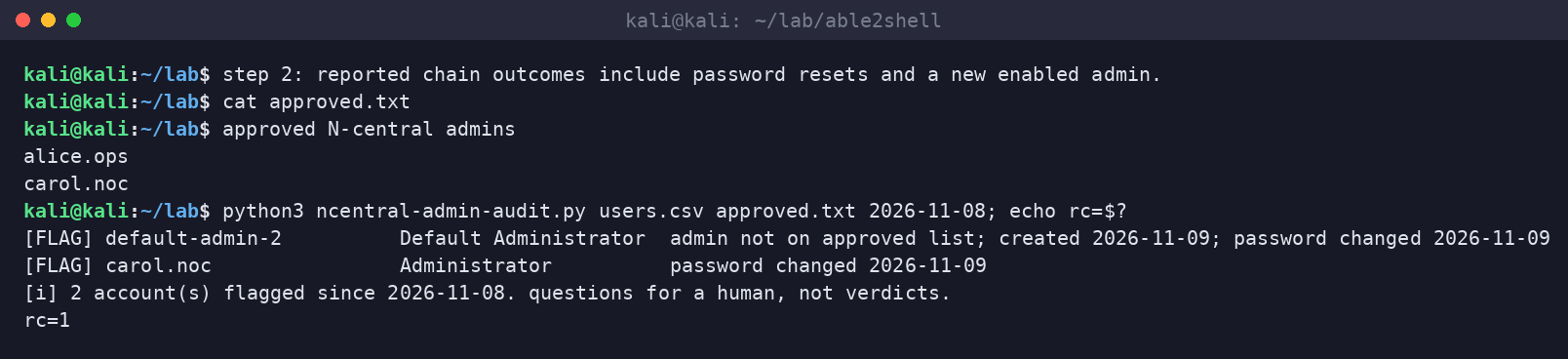
- audit accounts. reported outcomes include password resets and a new enabled administrator. check for admins nobody approved, and accounts created or password-changed since Nov 8. Huntress says review login activity from Nov 8 onward.
- look downstream. Huntress notes that in earlier N-central exploitation, attackers sprayed managed environments with scripts and tools. check for unexpected remote sessions and new scripts pushed to client endpoints.
- apply the hotfix when it ships, and only bring servers back when N-able says it is safe.

download the Kali defensive checks
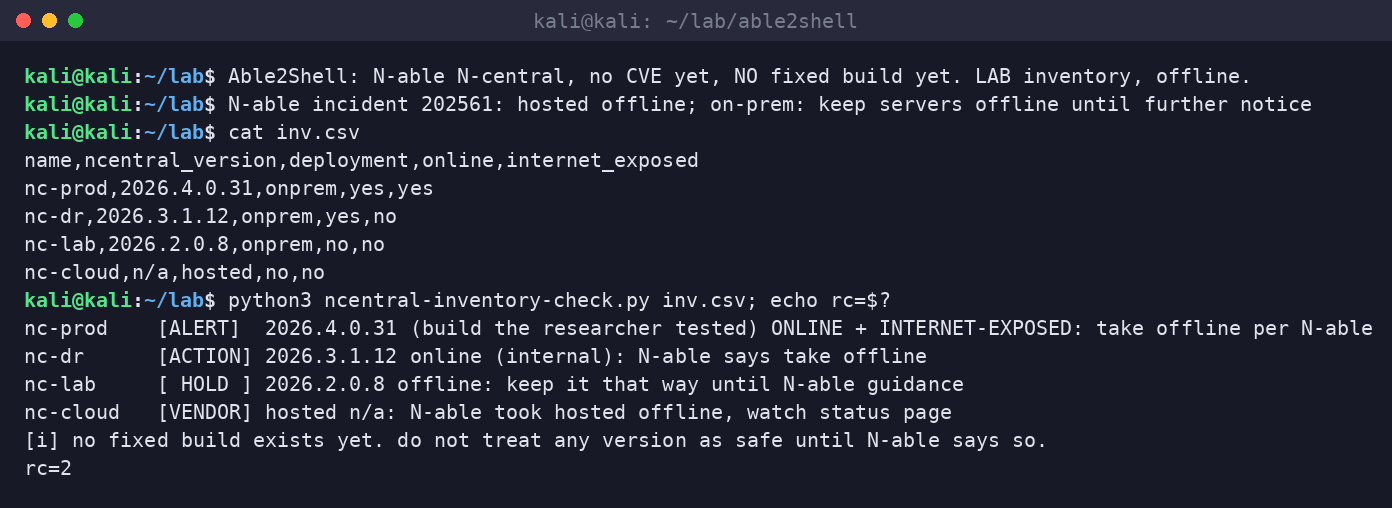
able2shell-ncentral-defensive-check.zip contains four defensive scripts. ncentral-inventory-check.py flags N-central servers that are still online or internet-exposed. ncentral-soap-log-grep.py flags SOAP service-import and XXE-style lines in logs you already have. ncentral-admin-audit.py flags unapproved admins and accounts created or reset since a date. ncentral-exposure-check.sh tests TCP reachability of a server you own and only prints a suggested allowlist. none of them fix anything, because there is no fixed version yet. follow N-able’s guidance and keep the server offline until the hotfix. none of them exploit anything, and none of them prove or disprove compromise on their own. export and log formats vary, so map fields first.
sloth take
an RMM is a single box that can run code on every machine at every client you have. that is the product. so when 30-plus bugs land in public with PoC code and the vendor’s best advice is “turn it off,” believe the vendor. yes, the outage hurts. a mass ransomware push through your own tooling hurts more, and it comes with a much longer phone call. switch it off, keep your logs, count your admins, and wait for the hotfix. the sloth is very good at waiting. be the sloth.
sources
- N-able, Status: IMPORTANT: N-central Critical Security Incident (event 202561) (started Nov 9, 2026 15:15 UTC; updates 19:59 UTC Nov 9 and 00:00 UTC Nov 10)
- BleepingComputer, N-able takes cloud platform offline after 30+ “zero-days” published (includes N-able statement and researcher interview)
- Huntress, N-able Disables Cloud Services Following Disclosure of “Able2Shell” Exploit Chains
- GovInfoSecurity, N-able Takes Platform Offline After 33 Zero-Days Drop
- Previdian, N-able N-central Critical Vulnerabilities: What We Know So Far and VULN-2026-0007
- CISA KEV catalog (checked version 2026.11.09: no Able2Shell entry)