

Scam-Baiting Without a Felony: Waste Their Time, Keep Your Freedom
scam-baiting is deeply satisfying and legally radioactive if you do it wrong. the appeal is real: every minute a scammer spends on a fictional “gladys” is a minute they are not draining a real pensioner. but the second you reach back into their machine, deploy a “payload,” or access their panel, you have committed the exact crime you are mad about. here is how to waste their time and collect reportable intel while staying firmly on the right side of the line.
why bait at all (and when not to)
two legitimate reasons: time-wasting as harm reduction, and intel collection for reports. good reasons to not bait: you are emotionally invested, you are using a real device or identity, or you are tempted to “teach them a lesson.” if any of those are true, just report and walk away. baiting is for calm people with disposable infrastructure, not for catharsis.
step 1: burner everything
never touch a scammer with anything real. disposable vm, snapshotted so you can roll back, on an isolated network. a fictional persona with a throwaway email. a pre-made fake “bank balance” screenshot if the script needs one. no real name, no real card, no real account, ever.
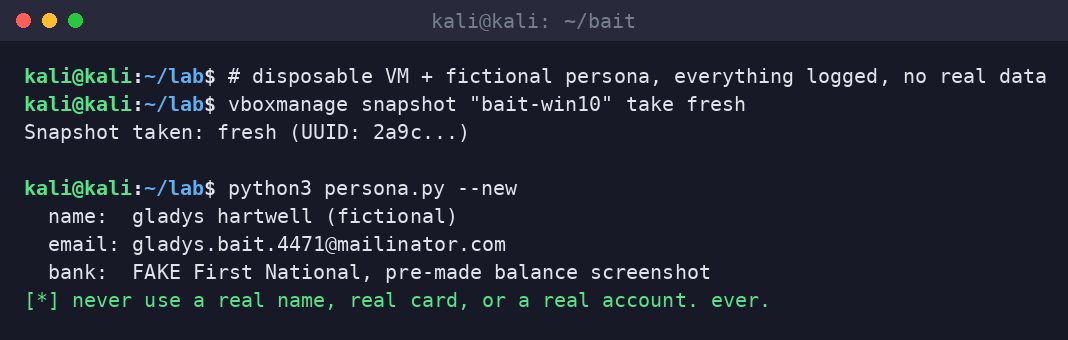
the persona exists to keep the scammer talking, not to con them back. if they connect, they connect to the burner vm and nothing else. this protects you (they cannot steal what is not there) and keeps the whole exercise clean.
step 2: keep them talking, record everything
intel comes from the interaction itself: the phone number, the domains they send you to, the ip the link resolves to, the rmm instance id and relay, the wallet or gift-card brands they demand, and the exact overpayment script they run. record the session (terminal with script, screen recording for the gui) so your evidence pack writes itself.
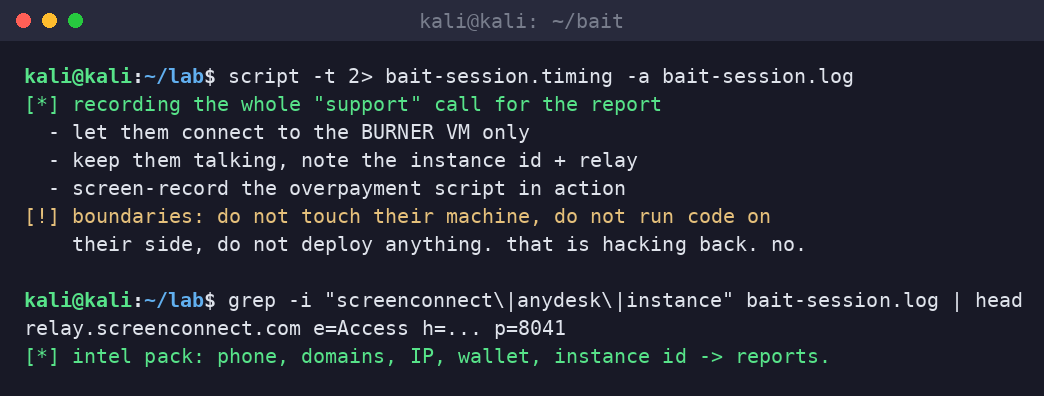
the boundaries, stated plainly because they matter more than the technique: do not access their machine. do not run code on their side. do not deploy anything, not even a “harmless” script. do not try to “get into” their panel even if they paste a link. the moment you do, you are the one with unauthorized access, and you have also contaminated the evidence so law enforcement cannot use it.
step 3: turn it into a report, not a youtube revenge arc
everything you collected feeds the pipeline from the previous article: abuse.ch for the indicators, hosting and registrar abuse for the takedown, the rmm vendor for the instance id, ic3 and ftc for the record, the exchange for the wallet. that is a real outcome. a viral clip of you yelling at a scammer is not.
what defenders and victims can do
- if you are not calm and disposable, do not bait. report and block. that is a complete, legitimate response.
- protect bystanders: never bait using a real company’s identity or a real person’s data. you can create liability for innocents.
- mind your jurisdiction: recording-consent laws vary. recording your own screen and your own vm is generally fine; know your local rules before you publish audio.
- hand it off: professional baiters and researchers (and groups that partner with law enforcement) can do more with your intel than a one-off clip can.
sloth take
the fantasy is you reaching through the wire and nuking the call center. the reality that actually hurts them is a burner vm, a fictional gladys who will not stop talking about her cat, and a tidy evidence pack that gets their vps suspended and their wallet flagged. be boring on purpose. boring is what keeps you out of a courtroom and keeps them out of business.
want help standing up a safe, legal research and baiting lab, or a fraud-intel workflow for your team? Book Dark Edge Consulting.
sources
- Computer Fraud and Abuse Act and equivalent anti-hacking statutes on unauthorized access and hacking back
- FTC and IC3 guidance on scam reporting
- abuse.ch submission platforms for turning interaction intel into shared indicators
- Lab artifacts generated on-box 2026-10-17 (synthetic bait session and terminal captures)